
Genetics Society of America
Using the tools of genetics and genomics, nearly 6,000 GSA members from more than 50 countries around the world investigate a wide variety of biological questions and applications.
Learn More

Learn more about why you should publish in the GSA Journals.
Why Publish With Us?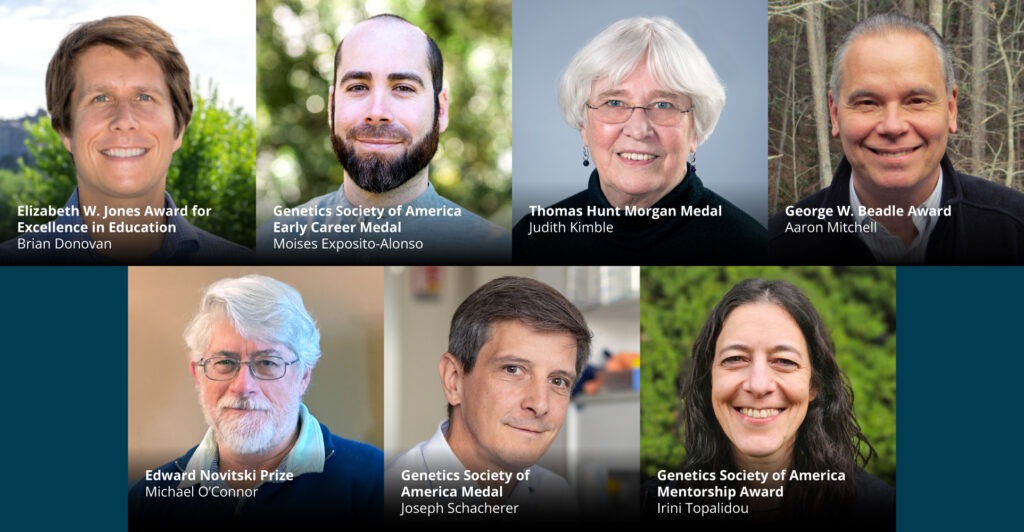
Past Events
2026 GSA Awards Seminars
In the 2026 series, Genetics Society of America Early Career Medal recipient Moisés Expósito-Alonso explored how natural selection reshapes plant populations over just a few generations. Drawing on large-scale, multiyear experiments with Arabidopsis, he examined how plants adapt to changing environments and what rapid environmental change means for genetic diversity, biodiversity, and conservation.
Thomas Hunt Morgan Medal recipient Judith Kimble highlighted discoveries that have shaped our understanding of how stem cells are regulated and how organisms develop. Her work spans stem cell niches, germline development, Notch and Wnt signaling, and the molecular mechanisms that determine sperm and egg cell fate.
George W. Beadle Award recipient Aaron Mitchell explored the development of genetic tools that have transformed research on pathogenic fungi, including Candida albicans. His contributions have advanced understanding of fungal genetics, pH sensing, biofilm formation, and pathogenesis while building a strong community through mentorship and training.
Edward Novitski Prize recipient Michael O’Connor discussed his decades of research on Drosophila development, including the development of molecular genetic tools and discoveries involving TGF-β and ecdysone signaling. His work has revealed how signaling pathways regulate development, body size, tissue growth, and hormone production.
Genetics Society of America Medal recipient Joseph Schacherer explored yeast population genomics, genetic diversity, and the architecture of complex traits. His work leading the 1,000 Yeast Genomes Project has established a valuable resource for understanding genetic variation, domestication, and mitochondrial genome evolution.
Genetics Society of America Mentorship Award recipient Irini Topalidou shared how the tiny worm Caenorhabditis elegans has guided her across research areas, disciplines, and career paths. Her seminar connected scientific discovery with mentorship, highlighting approaches to supporting trainees and improving career guidance.
2025 GSA Awards Seminars
In the 2025 series, Edward Novitski Prize recipient Kevin Struhl discussed functional expression and cloning of a eukaryotic protein-coding gene, the development of vectors for genetic manipulations in yeast, and reverse genetic analysis of DNA sequences and proteins that regulate gene expression, functional conservation of yeast and human proteins, and mechanistic links between transcriptional regulatory proteins and chromatin.
Genetics Society of America Medal recipient Noah Whiteman discussed how animals and other multicellular eukaryotes have gained novel adaptations through horizontal gene transfer from viruses and prokaryotes.
George W. Beadle Award recipient Sudhir Kumar traced his multi-decade academic journey from phylogenetics to Phylomedicine. He highlighted the inspiration behind widely used computational tools and the biological discoveries they enabled and explored how bridging methods and insights through data-driven approaches has advanced the understanding of species evolution to human disease.
Elizabeth W. Jones Award for Excellence in Education recipient Jason Williams discussed how DNALC tools and networks help bring DNA sequencing into the classroom—and why doing so is an urgent and effective way to build the STEM workforce.
Genetics Society of America Early Career Medal recipient Shinya Yamamoto explored how Drosophila melanogaster serves as a powerful model for uncovering the genetic roots of human diseases.
2024 GSA Awards Seminars
In the 2024 series, Edward Novitski Prize recipient Elaine Ostrander discussed the genetic underpinnings of domestic dogs, including breed-associated morphology, behavior, and disease susceptibility.
Elizabeth W. Jones Award for Excellence in Education recipient Jef Boeke (on behalf of Build-a-Genome) described how the Build-a-Genome course teaches students fundamental principles of genetics; how to perform, interpret, and troubleshoot experiments when the outcome is unknown; the course’s history and resultant network of course; impact on students and instructors; and impact on the International Sc2.0 project.
GSA Early Career Medal recipient Ofer Rog discussed two unpublished stories from his lab—the first documenting the unexpected de-mixing of sister chromatids during meiotic prophase and the mechanisms that mediate it and the second describing a new genomic technique his lab developed to characterize large-scale chromatic organization, and its application to meiotic chromosomes.
GSA Medal recipient Luciano Marraffini explored two defense systems developed by bacteria and archaea, which are constantly challenged by viral (phage) pandemics—restriction-modification and CRISPR—repurposed as powerful tools for genetic manipulations.
George W. Beadle recipient Deborah Andrew described her lab’s findings on how the Drosophila salivary gland is first specified and maintained, and how early and continuously expressed transcription factors control both secretory capacity and specificity, plus recent efforts using genome-wide approaches to discover how functional enhancers of downstream target genes are organized.
Thomas Hunt Morgan Medal recipient Paul Sternberg discussed the status of our knowledge of C. elegans—an intensively-studied research organism—and of how a genome sequence specifies the properties of an organism in the context of state-of-the-art technology and cool biology.
Watch all seminar recordings on YouTube here.
2022 GSA Awards Seminars
In the 2022 series, GSA Medal recipient Margaret “Minx” Fuller discussed her work on the regulation of proliferation and differentiation in the Drosophila male germ line adult stem cell lineage and the surprising contributions of cell type specific alternative mRNA processing to cell state changes.
George W. Beadle Award recipient Shirley Tilghman explored ways in which the profession might evolve in light of the challenges caused by the SARS-CoV-2 global pandemic.
Edward Novitski Prize recipient Harmit Malik’s seminar focused on his work on different mechanisms of meiotic drive in male and female meiosis, and how these conflicts profoundly shape centromere and chromatin packaging proteins, using Drosophila as a model system.
Thomas Hunt Morgan Medal recipient Michael Lynch discussed the paths of natural selection to evolutionary exploitation that are dictated by the population-genetic environment, which varies substantially among phylogenetic lineages.
Elizabeth W. Jones Award for Excellence in Education recipient Dara Ruiz-Whalen presented her theory, grounded in education and social sciences, that highlights aspects of science communication that open avenues for meaningful experiences for both scientists and science educators.
Elizabeth W. Jones Award for Excellence in Education recipient Alana O’Reilly showcased her work that challenges the hierarchy paradigm, instead putting project leadership directly in the hands of those naive trainees, encouraging them to embrace their identity, leverage their cultural and life experiences, and integrate these key social and societal factors into development of novel research.
Watch all seminar recordings on YouTube here.
2021 GSA Awards Seminars
In the 2021 series, Thomas Hunt Morgan Medal recipient Ruth Lehmann discussed how primordial germ cells are set aside from other cells in the body to fulfill their unique function in reproduction and how we have started to probe the quality control mechanisms that regulate the faithful transmission of cytoplasmic structures including mitochondria from the egg to the embryo.
George W. Beadle Award recipient Chao-tin Wu traced how the implication of genetics work is felt in our communities, specifically the journey from transvection and pairing to ultraconservation and then Amazon Prime.journey from transvection and pairing to ultraconservation and then Amazon Prime.
Elizabeth W. Jones Award for Excellence in Education recipient Edward J. Smith answered the question: What if we bring our hypothesis-testing, resource-development approach as scientists to our research-training efforts? This lecture provided a community-based approach to diversifying the biomedical workforce beyond the boundaries of one’s lab, department, interdisciplinary program, college, and university.
GSA Medal recipient Douglas Koshland discussed past and present examples of the critical importance of alternative alleles in elucidating important features of chromosome biology and to inform on the future of genetics in the CRISPR-dominated world.
Edward Novitski Prize recipient Feng Zhang discussed the growing appreciation for the natural diversity of CRISPR-Cas systems, adaptive immune systems microbes use to defend against invading foreign genetic elements.
Watch all seminar recordings on YouTube here.